Downlink Only What Matters
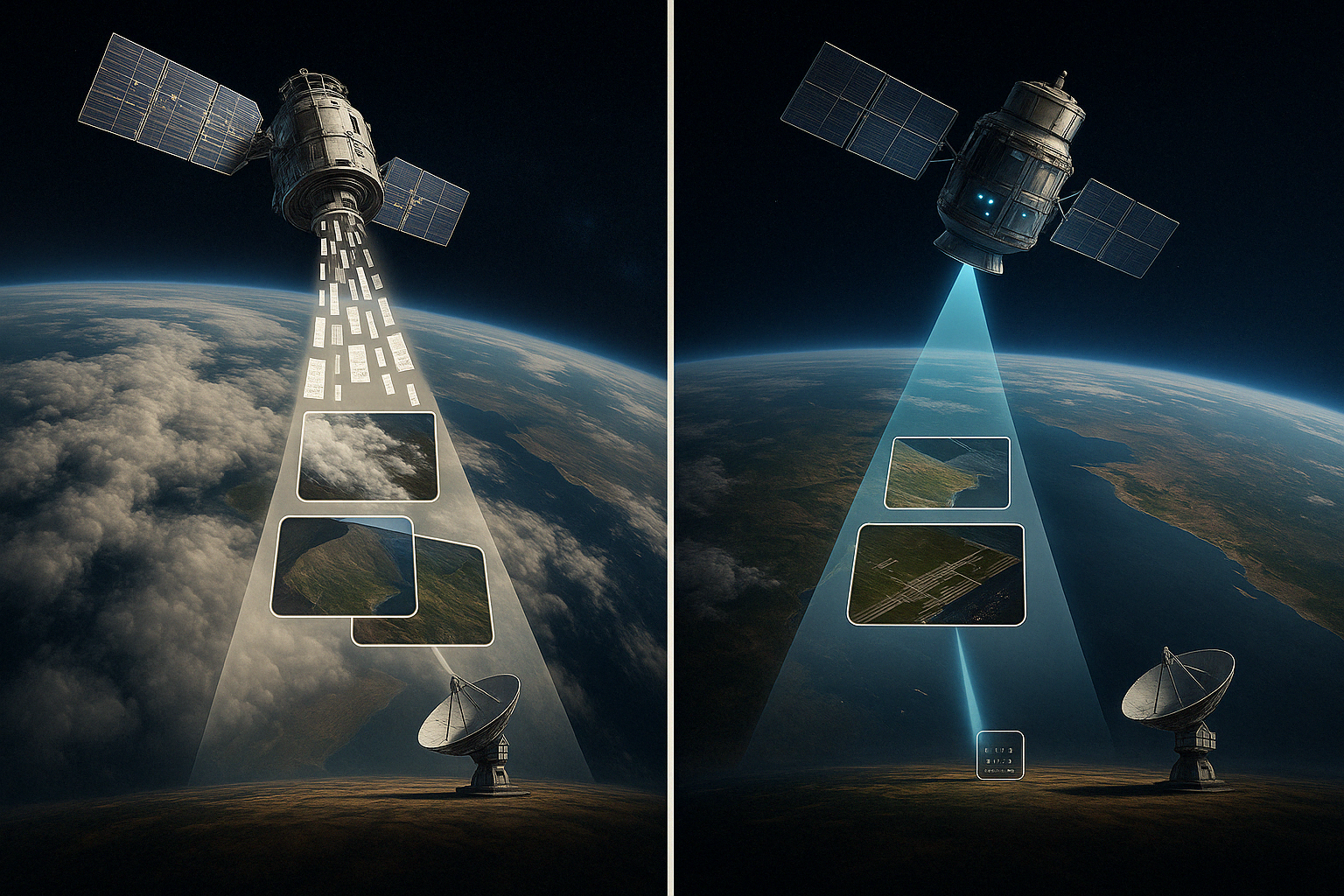
How onboard data quality assessment eliminates wasteful downlinks and revolutionizes satellite efficiency.
The Bandwidth Bottleneck
Imagine trying to stream 4K video through a dial-up connection. That's essentially what satellite operators face when downlinking data from orbit. Despite advances in satellite technology, bandwidth constraints remain a fundamental limitation in space operations.
The numbers are sobering: a single high-resolution Earth observation satellite can generate terabytes of data daily, but downlink capacity is severely limited by physics, regulations, and infrastructure. This bottleneck creates a critical challenge for organizations that need comprehensive global coverage and rapid updates.
The Problem with Blind Downlinks
Traditional satellites operate as "blind collectors" — capturing imagery and data without any awareness of quality or relevance. This leads to an extraordinary waste of precious bandwidth and operational resources:
- Cloud contamination: Up to 70% of Earth observation imagery contains clouds, yet operators blindly downlink all captures regardless of usability
- Off-nadir captures: Images taken at extreme angles that distort geography and reduce resolution are transmitted despite their limited utility
- Sensor misalignments: Hardware issues that compromise data quality go undetected until after transmission
- Calibration drift: Gradual sensor degradation creates data artifacts that are only discovered after extensive ground processing
These issues mean that satellite operators waste bandwidth on data that will ultimately be discarded, while delaying the delivery of truly valuable insights.
A New Paradigm: Onboard Quality Assessment
At Quanmo AI, we've developed a revolutionary approach through our onboard data quality assessment technology. Our satellites perform sophisticated quality analysis directly in orbit, before committing to bandwidth-intensive downlinks.
Our implementation includes:
Cloud Detection & Filtering
Advanced onboard algorithms that identify and quantify cloud coverage in real-time, prioritizing clear images and discarding heavily obscured captures that would be useless to analysts.
Off-Nadir Assessment
Real-time evaluation of capture geometry to prioritize downlinks of images taken from optimal angles, ensuring resources aren't wasted on distorted or low-utility perspectives.
Hardware Diagnostics
Continuous monitoring for sensor misalignments and hardware anomalies, with adaptive correction and prioritization based on actual data quality rather than scheduled maintenance.
Calibration Management
Onboard detection of calibration drift with real-time adjustments, ensuring that only properly calibrated, scientifically valid data is prioritized for transmission.
The Technical Foundation
Our implementation leverages radiation-hardened onboard processors running specialized computer vision and machine learning algorithms. These systems have been trained on millions of annotated satellite images to recognize quality issues with near-human accuracy.
By performing this assessment in orbit, we can make intelligent decisions about data priority and compression ratios, optimizing every bit of available bandwidth for maximum value. Our edge processing capabilities eliminate the need to wait for ground-based quality control, resulting in both bandwidth savings and dramatically faster insights.
The Quanmo Advantage
The results of our approach are transformative:
- 3x increase in useful data throughput without any change to existing ground infrastructure
- 85% reduction in cloud-contaminated imagery consuming valuable downlink capacity
- Near real-time notification of sensor issues, enabling proactive maintenance planning
- 70% faster delivery of actionable intelligence to end users
For time-sensitive applications like disaster response, this can mean the difference between actionable intelligence and missed opportunities. When monitoring flood zones or wildfire spread, every minute counts – our onboard quality assessment ensures that critical data reaches decision-makers first.
Beyond Efficiency: New Capabilities
Onboard quality assessment doesn't just improve efficiency – it enables entirely new operational capabilities:
- Dynamic tasking adjustments that can immediately retarget satellites when cloud coverage renders primary targets unobservable
- Intelligent burst modes that capture additional images only when quality conditions are optimal
- Adaptive calibration that maintains data quality even as sensors age or environmental conditions change
- Anomaly-driven scheduling that can automatically prioritize areas showing unexpected changes
These capabilities allow satellite operators to extract maximum value from their existing assets without hardware modifications or additional launches.
The Future of Satellite Intelligence
As we look to the future, onboard quality assessment will become a standard feature of all Earth observation systems. The days of blind collection and wasteful downlinks are ending, replaced by intelligent systems that can distinguish between valuable data and digital noise.
Organizations that embrace this shift will gain decisive advantages in operational efficiency, data timeliness, and intelligence quality. Those that remain with traditional blind collection methods will increasingly find themselves at a competitive disadvantage, wasting resources while delivering slower, less reliable insights.
The future of satellite operations isn't about collecting more data – it's about collecting better data, more efficiently. That future begins with onboard quality assessment.