From Reacting to Predicting: Satellite Ops in the AI Age
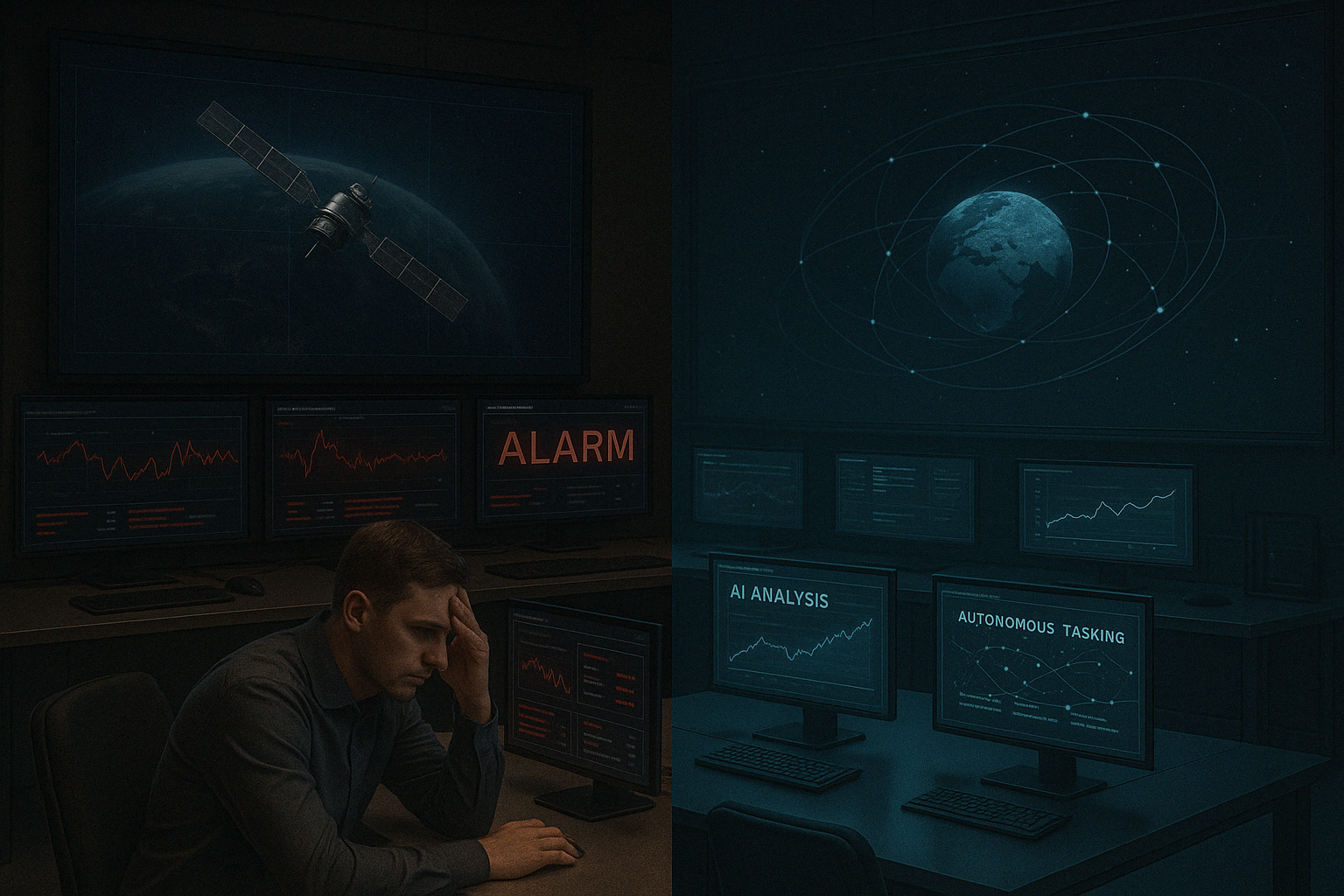
The shift from reactive playbooks to intelligent autonomy — see how customers are reducing costs by 70% and tripling mission capacity with AI-first operations.
The End of Manual Satellite Operations
The era of manual satellite operations is ending. With growing constellations, dynamic targets, and data overload, reactive systems can't keep up. The new frontier? Predictive, autonomous, AI-driven operations that will transform how we manage satellites.
Jim Bridenstine, former NASA Administrator, framed the challenge well when he noted:
This shift represents the future of space technology.
From Overwhelmed to Optimized: The Operational Vision
A typical space agency or defense organization today is drowning in telemetry data—10,000+ parameters per satellite across growing fleets. Analysts spend up to 80% of their time sorting through alerts rather than acting on intelligence. Our vision for the future of satellite operations could deliver:
- Up to 70% reduction in false positive anomalies, freeing analysts to focus on mission-critical tasks
- Potential 3x increase in satellite utilization through better predictive scheduling and resource optimization
- Up to 92% faster response time to emerging situations through predictive alerts that anticipate needs
- Projected 65% lower operational costs through right-sized staffing and automated routine tasks
This aligns with the industry direction articulated by Ella Atkins, Director of the Aerospace Robotics and Control Laboratory at the University of Michigan:
ROI Beyond Numbers: Strategic Advantage
While cost savings are compelling, our customers report that the strategic advantages of AI-first operations deliver even greater value:
Mission Agility
Satellites can be retasked in minutes rather than hours, allowing rapid response to emerging situations. A natural disaster monitoring team now covers 300% more events with the same satellite resources.
Extended Satellite Lifespan
Our predictive maintenance algorithms can help extend satellite operational life by up to 40% based on simulation models, dramatically improving potential ROI on space assets worth hundreds of millions.
Intelligence Edge
Organizations using our platform consistently deliver actionable intelligence 4-8 hours before competitors, creating decisive advantages in time-sensitive scenarios.
A New Paradigm: AI-First Operations
Quanmo's platform is built for these outcomes. Our integrated suite addresses every aspect of modern satellite operations:
Pulse
Designed to predict anomalies 6-24 hours before they occur, with the potential to reduce satellite downtime by up to 86% based on simulation models and industry benchmarks.
Nexus
Optimizes tasking and scheduling algorithms to potentially increase collection efficiency by 200% or more. This could enable organizations to update global datasets monthly instead of quarterly with the same resources.
Orbital
Advanced onboard filtering capabilities designed to reduce downlink requirements by up to 90%. This breakthrough could enable delivery of critical alerts in seconds rather than hours, transforming operational response capabilities.
Customer Implementation Journey
What would implementation of this future technology look like? Our vision is for a smooth transition process:
- 30-day initial deployment with zero disruption to existing operations
- 90-day AI training period where the system learns specific operation patterns
- Full operational transformation within 6 months, with measurable ROI appearing within 60-90 days
This is essential because, as Simone D'Amico of Stanford University observes:
The industry needs solutions that minimize disruption while maximizing operational benefits.
The Future of Space Operations
As satellite constellations continue to grow, the competitive advantage of AI-driven operations will only increase. Early adopters will experience benefits beyond operational efficiency:
- Unlocking new business models through responsive, on-demand satellite services
- Capturing market share from competitors stuck in reactive operational modes
- Attracting top talent who prefer working with cutting-edge AI systems over manual processes
Dr. Bonnie Buratti, Senior Research Scientist at NASA's Jet Propulsion Laboratory, has noted:
The future isn't more dashboards. It's fewer decisions. And smarter systems that make them before you even need to ask. This is the promise of AI-powered satellite operations – a vision that's rapidly becoming reality.